TL;DR
- Free speech recognition APIs and open source ASR engines cover a wide range of accuracy and latency profiles. The right option depends on whether you need real-time transcription, batch processing, or embedded on-device recognition.
- Most voice recognition API free tiers limit usage by minutes per month, concurrent requests, or language availability. Production volume exposes these limits within the first week.
- If you are evaluating free speech-to-text options to power a voice AI workflow, Dialora AI provides a faster path. Deployed voice agents handle calls, bookings, and follow-up without building an ASR pipeline first.
The engineer who scoped a free speech-to-text API integration at a bootstrapped SaaS company finished the proof of concept in three days. The free tier handled 300 minutes of transcription per month. Their first live test week produced 850 minutes. On day four, the API returned a 429 error on a demo call with a prospective enterprise client. She had been their first engineering hire and had never missed a demo before.
Free tiers are accurate until they are not. The voice recognition API free category is large, and the tradeoffs between options only appear at scale.
This guide covers what is actually available, what each option costs when you go beyond the free tier, and where Dialora AI fits for teams that need voice AI without a transcription pipeline build.
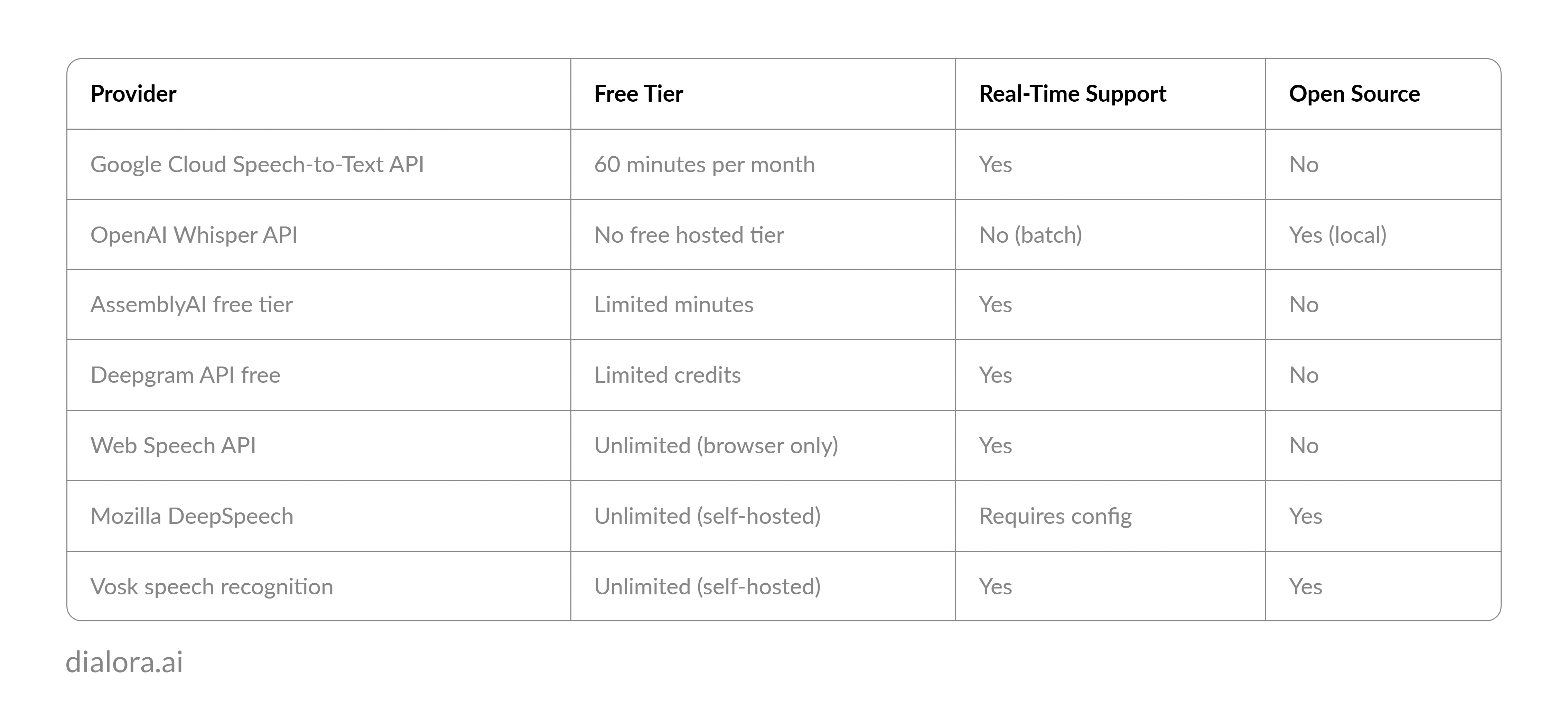
Free voice recognition APIs and open source ASR engines include Google Cloud Speech-to-Text free tier, OpenAI Whisper, AssemblyAI free tier, Deepgram free tier, Web Speech API, and Mozilla DeepSpeech. Each carries different limits on usage volume, language support, real-time capability, and deployment environment. Production voice AI applications typically exceed free tier limits within the first month of use.
What Do Free Speech Recognition APIs Not Tell You About Production Scale?
The free ASR engine evaluation usually starts with accuracy benchmarks. Accuracy matters. It is not the variable that causes production failures.
Volume limits cause production failures. Latency at concurrent load causes production failures. Language coverage gaps cause production failures. The best speech-to-text model for your demo conditions is often not the best one for your production conditions.
The top providers of voice API technology publish their free tier limits clearly. They do not publish what happens to your application when those limits are hit at 2 AM during an automated batch run.
Pro-tip: Every free speech recognition API has a ceiling. The ceiling matters more than the accuracy score for any production use case.
That is the frame.
How Do You Evaluate Free and Open Source ASR Options?
The voice recognition engine decision should start with the deployment environment, not accuracy rank. On-premises deployment and cloud API options carry fundamentally different operational requirements.
- Cloud-based free tiers: Google Cloud Speech-to-Text API free tier covers 60 minutes per month for standard models. The Google Cloud speech-to-text API free limit resets monthly. The Python library integrates cleanly and the accuracy on clear audio is among the best in the category. Latency on real-time streaming is competitive. The limit is the limit.
- Open source self-hosted options: Open source speech recognition engines like Vosk and Mozilla DeepSpeech run on-premises with no per-request cost after setup. They require infrastructure management, model updates, and GPU provisioning for real-time performance. The best free voice recognition API for a developer with server infrastructure available is often a self-hosted open source engine.
- Browser-native options: The Web Speech API runs entirely in the browser with no server cost and no setup. It is not suitable for server-side call processing or voice AI agents. Useful for browser-based interfaces where latency tolerance is higher.
The best speech-to-text model for a given use case is the one that clears your accuracy floor, fits within your budget at production volume, and operates in the deployment environment you actually run.
Top Free Speech-to-Text APIs and ASR Engines Compared
Before choosing a voice recognition API free option, verify it against your expected monthly volume and language requirements.
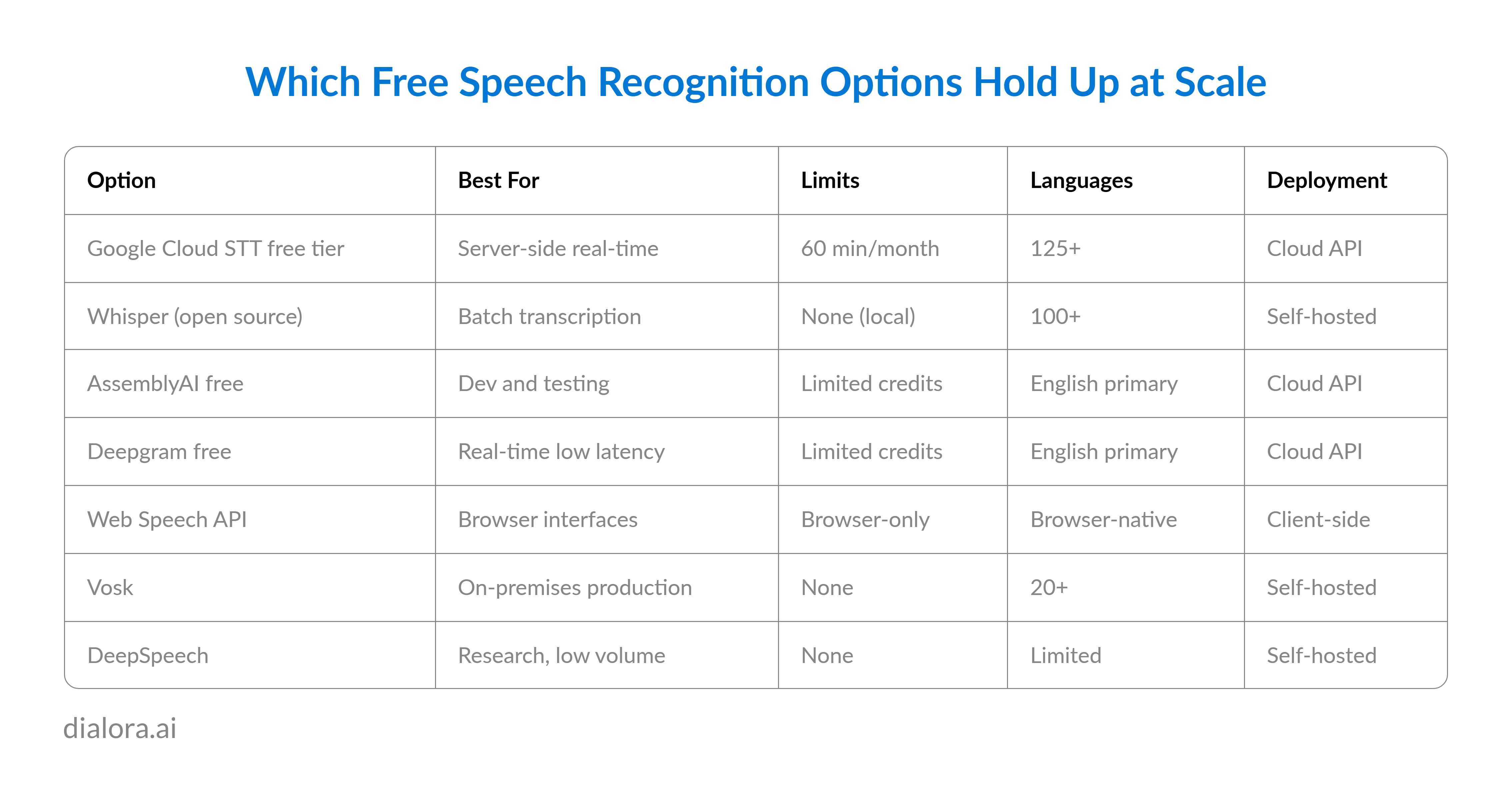
The speaker recognition API use case adds another layer to this evaluation. Most free speech recognition API options do not include speaker diarization in the free tier. Deepgram and AssemblyAI include it at paid tiers. Whisper does not support diarization natively.
Pro-Tip: The best ASR option for your project is the one your production environment can sustain, not the one that scored highest in a lab benchmark.
For teams evaluating voice AI APIs for on-premises deployment, Vosk and self-hosted Whisper are the two most common choices. Vosk runs lighter and supports real-time streaming more easily. Whisper produces higher accuracy on noisy audio but requires more compute for real-time use.
The real-time transcription API category is dominated by commercial providers at production scale. Deepgram leads on latency. AssemblyAI leads on accuracy for English. Google Cloud leads on language breadth.
Dialora AI uses best-in-class speech recognition as one layer of a complete AI voice agent platform. If you are evaluating free STT options because you want to build a voice AI system for handling calls, bookings, or customer intake, Dialora AI is the faster path. The platform handles the ASR layer, the NLU layer, the telephony integration, and post-call CRM sync. You configure the workflow logic via API.
Ready to See What a Full Voice AI Agent Handles Without Building an ASR Pipeline?
What the Free STT Evaluation Usually Leads To
The free-speech recognition API evaluation is often the first step of a longer build. Engineers test the STT layer, scope the NLU and dialogue management requirements, and realize the total build is six months of infrastructure work, not three weeks.
The voice recognition engine decision is one of four decisions that need to be made before a voice AI agent is production ready. The others are NLU architecture, telephony integration, and post-call data pipeline design.
Dialora AI resolves all four with one deployment. The free trial covers a real call workflow, not a sandbox. The platform operates across 30+ countries, handles five languages at production scale, and integrates with CRM via general API.
Frequently Asked Questions
Is the Google Speech-to-Text API free?
The Google Cloud speech-to-text API free tier covers 60 minutes of standard model transcription per month. Usage above 60 minutes is billed at standard Cloud Speech pricing. Real-time streaming and enhanced models carry different pricing. The free tier is sufficient for development and testing but typically covers less than one day of production call volume for most business applications.
What is the best free speech-to-text API?
The best free speech recognition API depends on your deployment environment and volume requirements. For server-side real-time transcription with cloud infrastructure, Google Cloud STT free tier or Deepgram free credits are common starting points. For unlimited local processing, OpenAI Whisper running self-hosted on GPU hardware is the highest-accuracy free option. Web Speech API covers browser-based use cases at zero cost.
Is there a free voice recognition API with no usage limits?
Open source speech recognition engines including OpenAI Whisper, Vosk, and Mozilla DeepSpeech have no per-request usage limits because they run self-hosted. The cost is infrastructure rather than per-minute billing. Commercial free tiers from Google, Deepgram, and AssemblyAI are limited by monthly usage caps. The best free voice recognition API with truly no limits means self-hosted open source.
How do I use the Google Speech Recognition API in Python?
The Python speech recognition library wraps the Google Cloud Speech-to-Text API for easy integration. Import the library, initialize a client with your service account credentials, load your audio file or stream, and call the recognize method with your config object specifying the language code and encoding. The Python library handles the gRPC calls to the Google Cloud STT endpoint and returns a transcription response object.
What is the difference between Whisper and Deepgram for free use?
OpenAI Whisper is available as an open source model for self-hosted deployment with no usage limits and no API cost. Accuracy on noisy audio is among the best in the open source category. Deepgram offers a free credits tier for cloud API access with real-time streaming support and lower latency than self-hosted Whisper for real-time use cases. Deepgram requires an API key and account. Whisper requires a server.