TL;DR
- Dialpad leads on real-time voice intelligence features, AI call transcription, and built-in sales coaching that runs during live calls without a separate integration.
- RingCentral leads on IVR routing system depth, ecosystem breadth with 300-plus CRM phone integration options, and a 99.999 per cent VoIP uptime SLA that holds up in enterprise procurement reviews.
- Neither platform handles autonomous call management. Teams that need inbound calls answered, appointments booked, or leads qualified without a human agent on the line are looking at a gap both platforms leave open.
The Dialpad vs RingCentral comparison has lived on IT shortlists for years. Both are cloud-based business phone systems with real enterprise credentials, real customer lists, and product teams that ship consistently. The mistake is not picking the wrong one between them. It is spending months on the comparison only to discover that the gap driving the decision, missed calls and unmanaged after-hours demand, is not something either platform solves.
Dialpad and RingCentral are both cloud-based business phone systems built for mid-market and enterprise teams. Dialpad leads on AI voice intelligence features and real-time call transcription. RingCentral leads on IVR routing system depth, CRM phone integration breadth, and VoIP uptime SLA commitments. The better platform depends on whether your primary gap is call intelligence or call infrastructure reliability.
How Dialpad and RingCentral Compare on Core Features
IT directors and communications managers typically run the Dialpad vs RingCentral features comparison across five dimensions: Dialpad pricing versus RingCentral pricing, reliability, AI capabilities, integrations, and support quality. The breakdown below reflects what both platforms actually deliver.
Dialpad vs RingCentral Feature Comparison for Business Communication Teams
One platform leads in intelligence. The other leads on infrastructure.
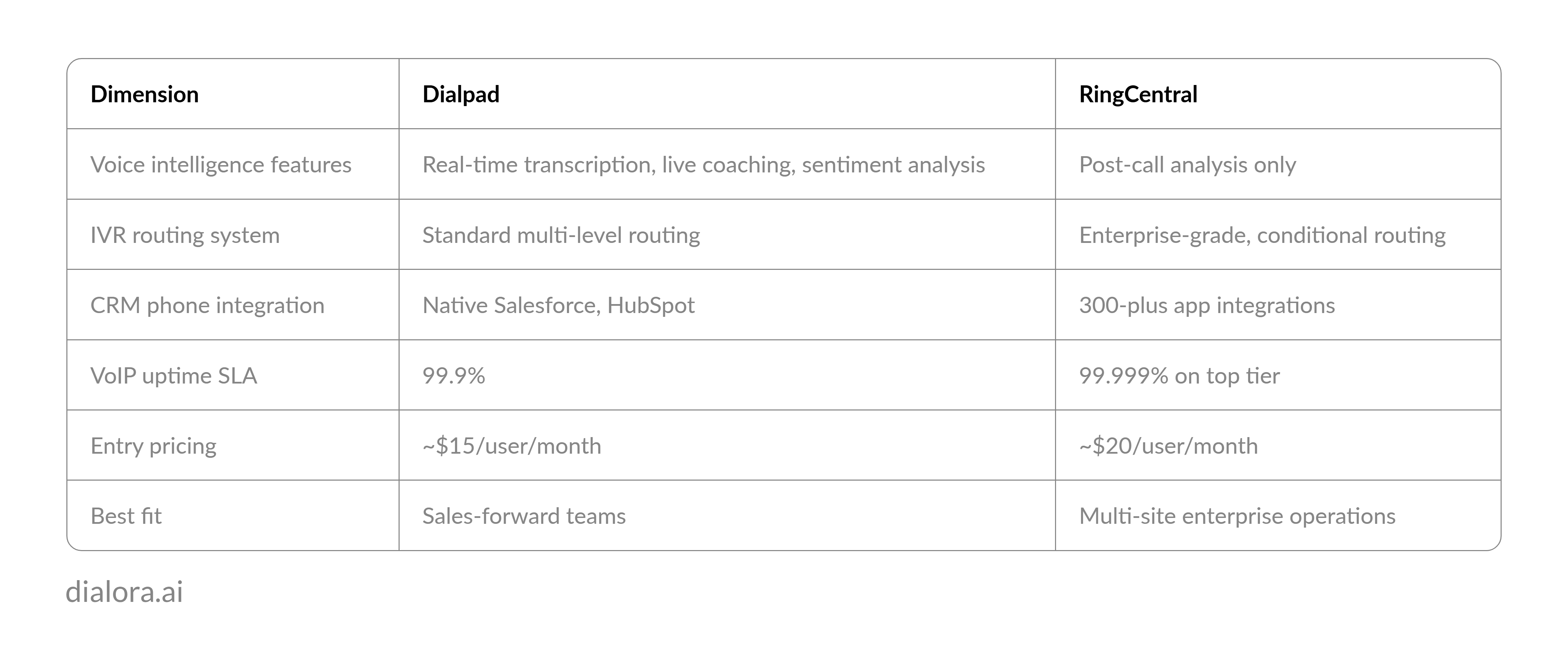
Dialpad pricing wins at the entry level. RingCentral pricing holds up better at large seat counts under enterprise contracts.
Pro-tip: RingCentral's 99.999 per cent VoIP uptime SLA is one of the strongest commitments in the cloud-based business phone system market. That single number wins enterprise procurement decisions.
What Are the Main Dialpad Limitations Enterprise Teams Report?
Dialpad's voice intelligence features are the product's genuine differentiator. Real-time coaching prompts appear during live calls. Sentiment analysis runs automatically. Call summaries are generated without manual effort.
The limitations show up in IVR routing complexity. A communications manager overseeing five regional offices tried to build conditional routing flows with Dialpad and hit the ceiling on the IVR routing system within three months. The platform routes calls effectively for most mid-market teams. It does not scale as cleanly as RingCentral at enterprise IVR depth.
Integration coverage outside Salesforce and HubSpot is thin. Worth checking against your tech stack before a Dialpad review conclusion. A Dialpad review that skips the integration audit misses the most common friction point.
What Do RingCentral Users Consistently Report as Missing?
RingCentral's business communication platform breadth is real. More than 300 integrations, enterprise-grade IVR routing system coverage, and a RingCentral pricing track record that survives procurement scrutiny. Not marketing copy. That is what gets it on shortlists.
Three things surface consistently in RingCentral review threads.
Pricing visibility: The Dialpad vs RingCentral cost comparison is hard to run accurately without a current RingCentral pricing quote because tiers shift.
Admin complexity: Teams that need fast onboarding find RingCentral's interface heavier to configure than Dialpad's.
AI capability lag: Voice intelligence features run post-call, not real-time, which a current RingCentral review from enterprise buyers flags consistently.
Pro-tip:
Neither Dialpad nor RingCentral was built to handle calls without a human on the other end. That is a different category entirely.
Your team has compared Dialpad and RingCentral. Here is what the comparison does not show yet.
Why Neither Platform Handles the Calls Your Team Cannot Staff
Here is where the Dialpad vs RingCentral comparison hits its real limit. Both platforms are built around human-staffed call handling. Dialpad makes humans smarter with better voice intelligence. RingCentral routes calls to the right humans with more precision.
When the human is not there, both platforms route to voicemail. It is a category constraint. Not a product flaw.
Teams that find this constraint costly are the ones with after-hours inbound volume, inbound lead flow that spikes unpredictably, or outbound follow-up sequences that need to run at scale without burning headcount on manual calls. Same problem. Every time.
Read more:
- Dialora AI vs. Bland AI
- Cognigy vs Sierra AI
- Dialora AI vs. Synthflow
- Bland AI vs Voiceflow
- Vapi vs ElevenLabs
- Synthflow vs Voiceflow
- Cognigy vs Kore.AI
- Sierra AI vs Decagon AI
- Cognigy vs Amelia
How Traditional VoIP Compares to AI Voice Agents for Autonomous Call Handling
The comparison changes when autonomous call management is the requirement.
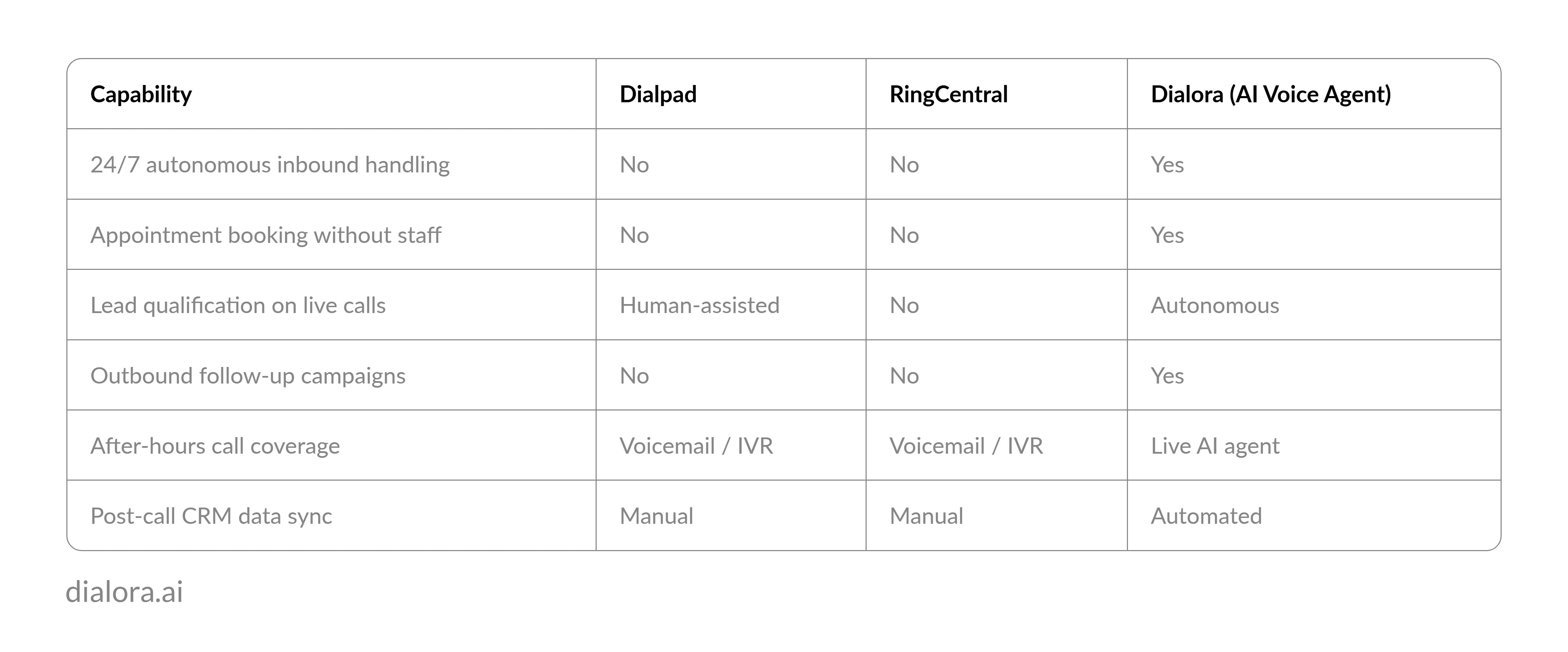
The question is not which is the best VoIP platform for small business. It is about who picks up when the team does not.
Dialora is an AI voice agent platform built for SMBs and enterprise teams that need calls handled around the clock without scaling headcount to match call volume. It takes inbound calls, books appointments, qualifies leads, and runs outbound follow-up using conversational AI voice agents that respond naturally and sync every call outcome to your CRM automatically. Teams running Dialora alongside their existing business communication platform stop losing the calls that fall through the staffing gaps both Dialpad and RingCentral leave open.
Why Picking the Right Platform Starts With One Question
Dialpad wins on call intelligence for sales-heavy teams. RingCentral wins on routing complexity and VoIP uptime SLA reliability for multi-site enterprise operations. If your gap is call intelligence, the Dialpad vs RingCentral features comparison resolves clearly toward Dialpad. If your gap is infrastructure depth, RingCentral holds up better at scale. The third question, which neither platform answers, is what happens to the calls your team cannot staff. Answering that first makes the rest of the comparison straightforward.
Frequently Asked Questions
Which is better, Dialpad or RingCentral, for a mid-market business?
The Dialpad vs RingCentral answer depends on your team's primary gap. Dialpad is the stronger choice for sales-heavy teams that need real-time voice intelligence, live call coaching, and built-in AI transcription. RingCentral leads for multi-site operations that require deep IVR routing system coverage, consistent VoIP uptime SLA performance, and broad CRM phone integration. Dialpad pricing starts lower. RingCentral pricing scales more predictably at high seat counts.
How does Dialpad pricing compare to RingCentral pricing?
Dialpad pricing starts around $15 per user per month at the base plan. RingCentral pricing starts around $20 per user per month, with enterprise tiers on contract. The Dialpad vs RingCentral cost gap narrows or reverses at high seat counts. Both vendors adjust pricing regularly, so request a current quote before comparing. Annual contracts on both platforms reduce per-user cost meaningfully.
What do real Dialpad and RingCentral reviews flag consistently?
Dialpad review threads most frequently cite IVR routing system limitations and thin integrations outside Salesforce and HubSpot. RingCentral review threads flag pricing complexity, admin interface weight, and voice intelligence features that trail Dialpad on real-time capabilities. The Dialpad vs RingCentral uptime reliability comparison is roughly comparable for standard mid-market deployments, with RingCentral's 99.999 per cent SLA mattering more at the enterprise tier.
Can Dialpad or RingCentral handle calls without a human agent?
Neither platform handles calls autonomously. Both use IVR routing systems to direct calls to human agents or voicemail. For teams that need inbound calls answered, leads qualified, or appointments booked without a live agent, conversational AI voice agents like Dialora handle that layer independently. Dialora runs 24/7 and syncs every outcome to connected CRM platforms automatically.
Is Dialora secure and compliant for business communication operations?
Dialora operates on SOC 2-ready infrastructure with end-to-end encrypted call handling and GDPR compliance across its 30-plus country footprint. Healthcare teams can request a Business Associate Agreement. Dialora connects via API to Google Calendar, Cal.com, TidyCal, and CRM platforms. Full compliance documentation is available at dialora.ai/docs.