TL; DR
- Vapi is a developer-first voice AI platform built for orchestrating full voice agents: STT, LLM, TTS, telephony, warm call transfer, appointment booking, post-call analysis, and outbound AI calls from a single API layer. ElevenLabs is a voice synthesis platform known for ultra-realistic TTS, now expanding into conversational AI with ElevenLabs Flash v2.5.
- The Vapi vs ElevenLabs comparison is not a direct head-to-head of equivalent platforms. Vapi orchestrates the entire voice agent stack. ElevenLabs is frequently used as the TTS voice provider inside that stack, including inside Vapi itself.
- Dialora is the autonomous AI voice agent platform for teams that need inbound and outbound call handling running without an engineering build cycle, offering Dialora Integrations with leading CRM and scheduling tools, transparent Dialora AI pricing, and deployment in days.
Technical CTOs and conversational engineers evaluating Vapi vs ElevenLabs are often comparing two tools that solve overlapping but distinct problems. ElevenLabs started as the best voice synthesis platform in the market and has evolved into a conversational AI platform with ElevenLabs Flash v2.5. Vapi started as a developer-friendly voice orchestration layer and has become the default choice for AI product leads who need a full voice agent infrastructure: STT via Deepgram or similar, LLM integration with OpenAI GPT-4o or other models, TTS from providers including ElevenLabs, and telephony via Twilio. The question is not which platform wins outright. The question is what role each plays in your voice AI stack and whether that stack requires a custom build or an out-of-the-box autonomous call-handling layer.
Vapi is a developer-first voice AI platform for orchestrating full voice agent pipelines: speech-to-text, LLM integration, text-to-speech, telephony, warm call transfer, and post-call analysis from a single API. ElevenLabs is a voice synthesis and TTS platform with conversational AI capabilities added via ElevenLabs Flash v2.5. The two are not direct substitutes. ElevenLabs is often used as the TTS voice provider inside a Vapi deployment.
Vapi vs ElevenLabs: What Each Platform Actually Does
Understanding the Vapi vs ElevenLabs comparison requires separating voice orchestration from voice synthesis.
Vapi is a voice orchestration layer. It connects STT providers like Deepgram, LLM providers like OpenAI GPT-4o, and TTS providers, including ElevenLabs, into a single coherent voice agent pipeline. Vapi handles the turn-taking model that makes conversations feel natural rather than mechanical, manages telephony via Twilio and other providers, supports warm call transfer to human agents, enables knowledge base integration for contextual responses, and outputs post-call analysis automatically. Vapi pricing is usage-based per minute. Vapi reviews from AI developers and conversational engineers on G2 consistently highlight the API depth, the flexibility to swap providers at each layer, and the developer documentation quality as primary strengths.
ElevenLabs is a voice synthesis platform. Its core product is TTS that produces the most natural-sounding AI voices in the market, covering a wide range of languages and voice styles. ElevenLabs Flash v2.5 is its conversational AI interface that enables real-time voice interaction directly through ElevenLabs without a separate orchestration layer. ElevenLabs pricing scales by character count and voice usage tier. ElevenLabs reviews on G2 from audio engineers and AI product leads highlight exceptional voice quality and the breadth of the ElevenLabs Integrations catalogue as genuine strengths. ElevenLabs alternatives searches typically surface when teams need more telephony depth or full voice agent orchestration than ElevenLabs covers natively.
Key-Note:
ElevenLabs is often used inside Vapi, not instead of Vapi. If the build needs full voice agent orchestration with telephony, warm call transfer, and post call analysis, Vapi is the platform. If the build needs best-in-class TTS voice quality as a component, ElevenLabs is the provider.
Vapi vs ElevenLabs: Feature Comparison for Technical Teams
The head-to-head that matters for CTOs and conversational engineers choosing a voice AI platform architecture.
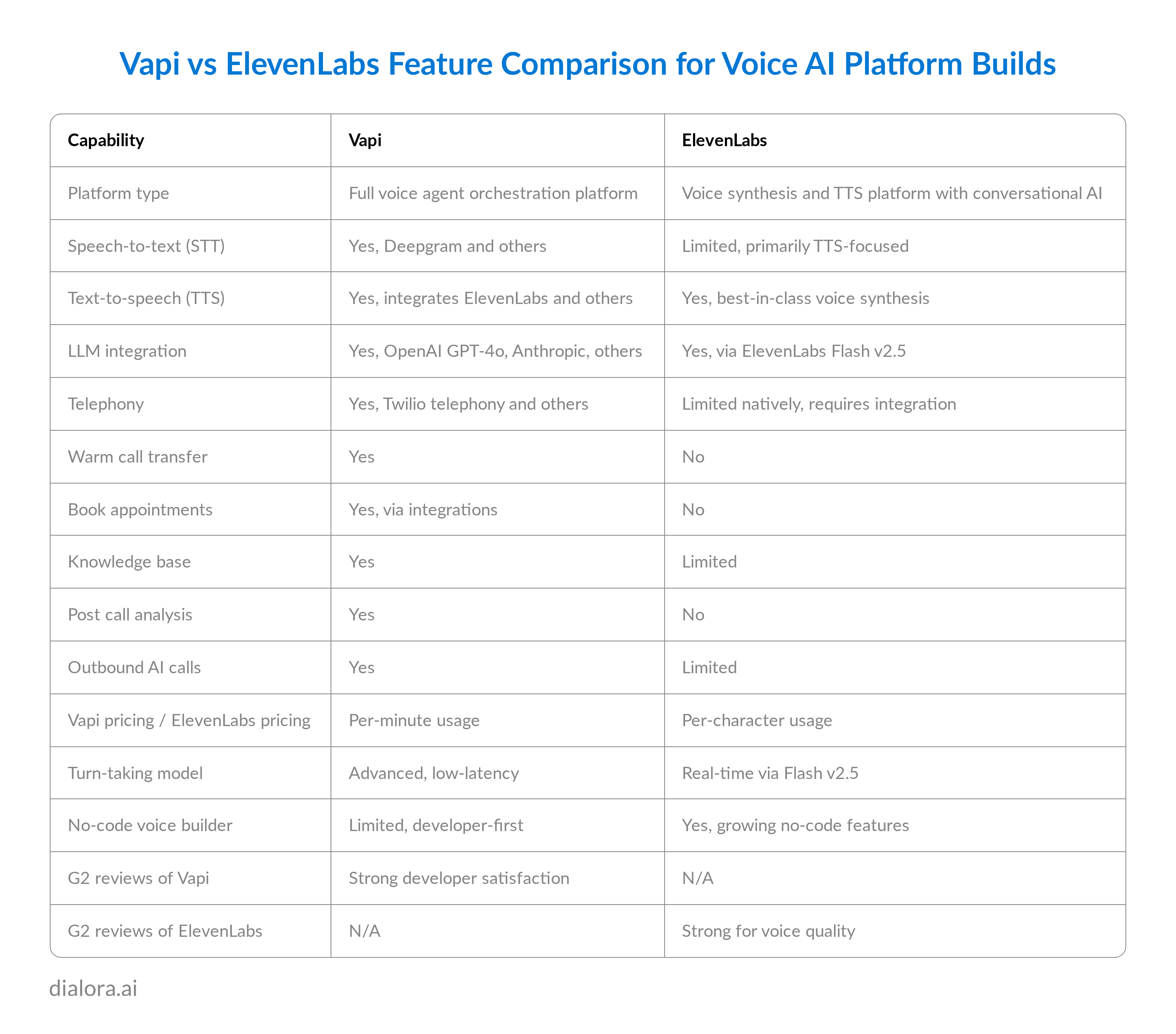
Vapi Integrations cover the full stack: STT, LLM, TTS, telephony, CRM, calendar, and webhooks. ElevenLabs Integrations are broader on the audio and publishing side and narrower on the telephony and contact center side. The Vapi vs ElevenLabs decision for a production voice agent build almost always resolves to using both: Vapi for orchestration, ElevenLabs for voice.
Read more:
- Dialora AI vs. Bland AI
- Dialora AI vs. Synthflow
- Bland AI vs Voiceflow
- Synthflow vs Voiceflow
- Cognigy vs Kore.AI
- Cognigy vs Sierra AI
- Dialpad vs RingCentral
- Cognigy vs Amelia
What Technical Teams Report When Building With Vapi and ElevenLabs
The G2 reviews of Vapi and G2 reviews of ElevenLabs tell a consistent story about where each platform delivers and where the gaps appear.
Vapi reviews from conversational engineers running production voice agents highlight three consistent strengths: the turn-taking model is the best available for natural phone conversations, the Deepgram STT plus OpenAI GPT-4o LLM combination inside Vapi produces strong response quality, and warm call transfer works reliably in enterprise CCaaS deployments. The consistent friction point is build time. A production-ready inbound customer support AI agent on Vapi takes a skilled conversational engineering team two to four weeks at minimum, covering telephony setup via Twilio, voice orchestration configuration, knowledge base integration, and post-call analysis output.
ElevenLabs reviews from AI product leads consistently rate the voice synthesis quality as unmatched. ElevenLabs Flash v2.5 reduced the latency gap with competitors significantly. The friction point is scope: teams that need full telephony, warm call transfer, appointment booking, and AI call center automation discover quickly that ElevenLabs' conversational AI layer covers voice output well and stops short of the full voice agent for the business stack.
Conversation AI deployments that need telephony, transfers, and analysis require more than voice synthesis alone. Both platforms are tools for teams that have the engineering resources to build and maintain voice agent infrastructure. That is a legitimate and powerful use case.
It is not the use case for every team that needs autonomous call handling.
What Both Platforms Require That Dialora Covers Natively
Vapi without a conversational engineer is an API with no call flows. ElevenLabs Flash v2.5, without a technical integration layer, is a voice without a phone number.
The gap is specific. AI call center operations that need to go live in days, not after a sprint. Inbound customer support AI that answers calls 24/7 without an agent on duty. Outbound AI calls that run campaigns without a rep dialling. Post call analysis that syncs to CRM without a custom webhook. Appointment booking on live calls without a developer managing the flow. Every time.
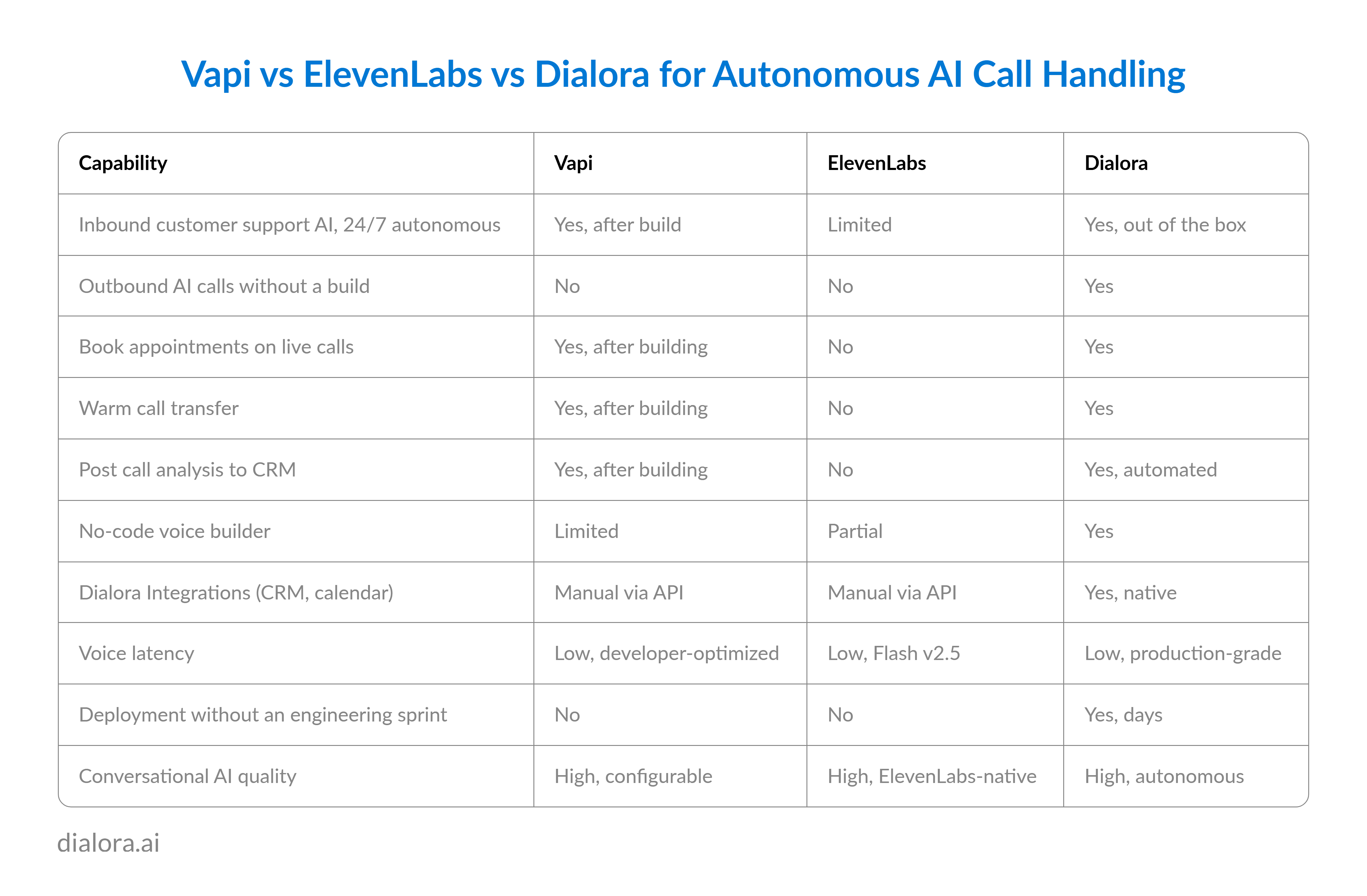
Dialora is not a Vapi replacement for teams building custom voice AI platform pipelines with specific STT, LLM, and TTS configuration requirements. It is the autonomous voice agent for business teams that need inbound and outbound call handling live without an engineering build cycle. Dialora Integrations connect natively with Google Calendar, Cal.com, TidyCal, and CRM platforms via API. Dialora reviews from AI call center teams and AI receptionist deployments are available at dialora.ai. Dialora AI pricing is usage-based and transparent, unlike Vapi pricing, which accumulates across the STT, LLM, TTS, and Twilio telephony layers separately.
Ready to See Autonomous AI Call Handling Without the Engineering Build?
Vapi vs ElevenLabs vs Dialora: Which Fits Your Voice AI Architecture?
The best voice AI platform 2026 comparison and the broader AI voice platform comparison category separate cleanly into builder platforms and autonomous platforms. The Vapi vs ElevenLabs decision resolves cleanly once the architecture question is answered. If the build is developer-led and requires a custom STT, LLM, and TTS stack configuration with full control over voice orchestration, telephony via Twilio, and turn-taking model tuning, Vapi is the right platform, and ElevenLabs is the right TTS provider to use inside it. The combination of Vapi plus ElevenLabs Flash v2.5 voice is a strong production architecture for technical teams with conversational engineering resources. If the requirement is autonomous inbound and outbound call handling for an AI receptionist, AI call center, or outbound campaign running without a build cycle, Dialora is the right platform. Matching the platform to the team's capability and timeline is the decision. Builder tools and autonomous platforms both have a place in the voice AI stack. They are not substitutes.
Frequently Asked Questions
What is the key difference between Vapi and ElevenLabs as voice AI platforms?
Vapi is a full voice AI platform for orchestrating voice agent pipelines: speech-to-text via Deepgram, LLM integration via OpenAI GPT-4o and others, text-to-speech including ElevenLabs, telephony via Twilio, warm call transfer, knowledge base, and post-call analysis. ElevenLabs is a voice synthesis platform delivering best-in-class TTS, expanding into conversational AI via ElevenLabs Flash v2.5. ElevenLabs is often used as the TTS layer inside a Vapi deployment. The two platforms are complementary more than competitive.
How does Vapi pricing compare to ElevenLabs pricing?
Vapi pricing is usage-based per minute of voice agent call time, with separate costs for STT, LLM, and TTS providers used inside the pipeline. ElevenLabs pricing is per-character for TTS and scales with the voice usage tier. Both are transparent usage-based models. Dialora AI pricing is also usage-based and available at dialora.ai for teams comparing total autonomous call handling deployment cost against a custom Vapi plus ElevenLabs build.
What do G2 reviews of Vapi and G2 reviews of ElevenLabs say about each platform?
G2 reviews of Vapi from conversational engineers consistently highlight strong API documentation, provider flexibility across the STT, LLM, and TTS layers, reliable voice latency, and warm call transfer performance as primary positives. G2 reviews of ElevenLabs highlight exceptional voice synthesis quality, broad ElevenLabs Integrations support, and ElevenLabs Flash v2.5 latency improvements as consistent strengths. Both platforms receive strong G2 ratings within their respective categories.
What are the main Vapi alternatives and ElevenLabs alternatives for production voice agent builds?
Vapi alternatives for full voice agent orchestration include Retell AI and custom stacks built directly on Twilio with Deepgram and OpenAI GPT-4o. ElevenLabs alternatives for TTS voice quality include PlayHT, Cartesia, and Deepgram's voice synthesis output. For teams that want autonomous call handling without a custom build, Dialora is a production-ready AI voice agent for business covering inbound, outbound AI calls, appointment booking, and post-call analysis without engineering overhead.
Is Dialora compliant, and how do Dialora Integrations work for enterprise teams?
Dialora operates on SOC 2-ready infrastructure with GDPR compliance across 30-plus countries. Healthcare teams can request a Business Associate Agreement. Dialora Integrations connect natively with Google Calendar, Cal.com, TidyCal, and CRM platforms via API, covering the core appointment booking and post-call analysis workflows that Vapi and ElevenLabs require custom integration to achieve. Dialora reviews, Dialora AI pricing, and full integration documentation are available at dialora.ai.