TL;DR
- The gap is not a scoring problem. Marketing's qualified-lead number and sales' number never match, and teams keep tightening the model. The real cause is usually how many leads got contacted, and how fast.
- Most leads have never worked at all. A Harvard Business Review audit of 2,241 US companies found 23% never responded to a test lead, and a 2024 repeat across 1,000 B2B SaaS companies put it at 63.5%. 79% of marketing leads never convert, mostly for lack of follow-up.
- Speed beats fit, by a wide margin. Contacting an inbound lead within the first hour converts MQL to SQL at 53%, against 17% after 24 hours. Same leads, same team. The industry average response time is 42 to 47 hours.
- Four layers, in order. Enrich the record, score it on fit and intent separately, contact it immediately, then route it with the transcript attached. Each layer inherits the quality of the one before it.
- Scoring reorders, contact changes the denominator. Salesforce's State of Sales reports roughly a 30% conversion lift from AI prioritisation, and vendors quote two to three times that. Plan against 30%, and remember scoring does not call anybody.
One line: measure your median response time before you buy a model, because a 53% versus 17% split from timing alone costs nothing to investigate.
Ask your marketing team how many qualified leads they produced last quarter. Then ask sales how many they received. The two numbers will not match.
Almost every team reads that gap as a scoring problem and responds by tightening the model. Lead volume falls, the board asks about pipeline, and the scoring gets loosened again six months later. The cycle repeats because the diagnosis is usually wrong.
The gap is rarely about which leads you picked. It is about how many you actually contacted, and how fast. A Harvard Business Review audit of 2,241 US companies found 23% never responded to a web-generated test lead at all, and a 2024 repeat of that test across 1,000 B2B SaaS companies put the figure at 63.5%. Meanwhile 79% of marketing leads never convert to a sale, most often for lack of follow-up rather than lack of fit.
AI changes both halves of that, but not equally. Scoring changes the order of your list. Contact changes how much of the list gets worked at all. Most of the available revenue sits in the second one.
Why does lead qualification fail before scoring even matters?
Because a scoring model reorders a queue, and a queue that nobody works produces the same revenue in any order. Before you spend on AI lead scoring, check whether your leads are being contacted, and how quickly. In most funnels that single variable moves more pipeline than any model change.
Speed decides the outcome more than fit does
This is the most consistently replicated finding in lead management research, and it is much larger than most teams assume:
- 53% versus 17%. B2B companies contacting an inbound lead within the first hour convert MQL to SQL at 53%. The same companies contacting after 24 hours convert at 17%. Same leads, same definitions, same sales team.
- 21 times more likely at five minutes. The MIT and InsideSales Lead Response Management study found contacting within five minutes made qualification 21 times more likely than contacting at thirty.
- Seven times, then sixty times. Harvard Business Review's analysis of 1.25 million leads across 42 companies found firms contacting within an hour were nearly seven times as likely to reach a decision maker as those waiting an hour longer, and more than sixty times as likely as those waiting a day.
- The industry average is 42 to 47 hours. Which places most teams firmly in the 17% column while they are busy debating scoring criteria.
A three-fold conversion difference from timing alone is larger than any lead scoring uplift published by any vendor. If your median response time is measured in hours, the model is not your constraint.
How do you automate lead qualification using AI?
In four layers, applied in order: enrich the record, score it, contact it, then route it with context attached. The order matters because each layer inherits the quality of the one before it. Teams who start at scoring are building on whatever their CRM happens to contain.
Layer one: enrich, because scoring inherits your data
Predictive models are unusually good at learning the wrong pattern from incomplete records. Duplicate contacts, missing firmographics and stale job titles do not make a model uncertain, they make it confidently wrong. Published guidance puts the accuracy gain from clean, complete inputs at up to 60%, which is a larger swing than most model choices produce.
Enrich before the lead is scored, not after. Firmographics, headcount, funding stage, technographics and a verified contact number are the inputs the next three layers depend on.
Layer two: AI lead scoring, and what it genuinely changes
AI lead scoring replaces hand-built point systems with a model trained on your own conversion history. The practical version separates two dimensions rather than producing one blended number:
- Fit. How closely the lead matches your ideal customer profile. Industry, size, role, geography, budget band.
- Intent. How actively they are showing buying behaviour right now. Pages viewed, demo requested, pricing page visits, email engagement, product usage.
- The four quadrants drive different actions. High fit and high intent goes to a rep immediately. High intent and low fit gets deprioritised before anyone wastes a call. High fit and low intent goes to nurture rather than to the bin.
On results, be careful which number you accept. Salesforce's State of Sales research reports roughly a 30% lift in conversion for teams using AI-driven prioritisation over rule-based or no scoring. Vendor marketing routinely quotes figures two to three times higher. 30% is the number to plan against.
And the structural limit is worth stating plainly: scoring reorders your list. It does not call anybody.
Layer three: AI voice calls, which change the denominator
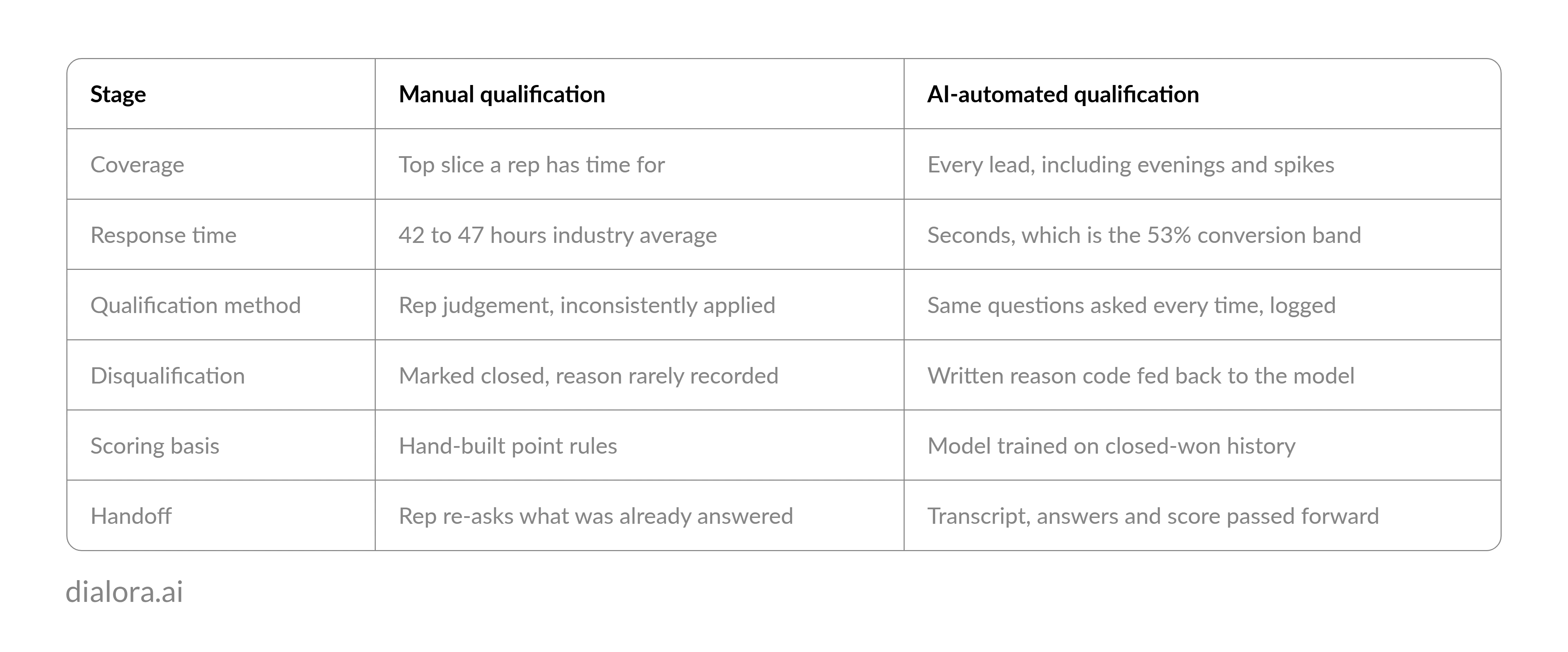
This is where most of the recoverable revenue actually sits. A rep works one lead at a time and stops at 6 p.m. An AI voice agent picks up or dials out the moment a form is submitted, at any hour, across every lead rather than the top slice a human has time for.
- It removes the response-time variable entirely. Contact happens in seconds rather than hours, which moves you from the 17% column to the 53% column before any other change.
- It asks the qualifying questions in conversation. Budget band, decision authority, current solution, timeline. The caller answers in their own words rather than picking from a menu.
- It books, disqualifies or nurtures with a reason attached. A disqualified lead carries a written reason code, which is the training signal your scoring model needs and rarely receives.
- It covers the leads nobody was ever going to call. The bottom sixty percent of the list, evenings, weekends and volume spikes. This is the denominator change, and it is the part scoring cannot do.
Layer four: route with context, and hold the SLA
The handoff is where automated qualification quietly loses its value. A rep who receives a qualified lead with no record of what was discussed will ask the same four questions again, and the prospect will conclude nobody is listening. Pass the transcript, the answers, the score and the reason. Then enforce a response SLA as a live condition rather than a reported metric.
Which AI lead qualification tools should you actually use?
Start with what your CRM already includes, because integration cost usually exceeds the difference between models. Add a specialist layer only where the native tool genuinely cannot reach.
CRMs with native AI scoring
- HubSpot. Predictive scoring with Breeze Intelligence enrichment. The natural first choice for HubSpot shops, though predictive tiers sit in Marketing Hub Professional and above, which starts around $800 per month.
- Salesforce Einstein Lead Scoring. Trained on your historical conversion data, and it explains why a lead received its score, which matters when reps need to trust the number. Lowest friction option for Salesforce teams.
- Zoho CRM with Zia, Pipedrive and Freshsales. Built-in AI scoring at substantially lower price points, well matched to SMB and mid-market motions that do not need account-based depth.
Specialist scoring and intent platforms
- 6sense and Demandbase. Account-based intent scoring using off-site buying signals. Powerful and expensive, with enterprise contracts typically starting in the tens of thousands annually.
- MadKudu. Strong fit for product-led growth motions where product usage is the primary intent signal.
- Conversica. Layers automated follow-up messaging on top of scoring, aimed at inbound-heavy teams with more leads than reps.
AI voice agents for lead qualification
- Dialora. Our own platform, listed for completeness. Inbound and outbound AI voice agents that contact every lead within seconds, run the qualifying conversation, book or disqualify with a reason, and hand off to a rep on request. Best fit when lead volume genuinely exceeds what your team can call. Wrong fit for low-volume, high-value enterprise deals where a founder should be making the call.
- Other voice AI platforms. Bland AI, Retell and Vapi all support qualification flows with varying amounts of engineering required. Evaluate them on latency, telephony reliability and how cleanly they hand off, not on demo polish.
Conclusion
The gap between marketing's number and sales' number is real, but it is usually measuring the wrong thing. Most of it is not leads that failed to qualify. It is leads that were never called, or called two days after they asked.
Which makes the sequence clear. Measure your median response time first, because a 53% against 17% conversion split from timing alone is larger than any scoring uplift on the market and costs nothing to investigate. Then enrich, so the model has something real to learn from. Then score. Then automate the contact, so the bottom of the list gets worked at al
Keep the judgement called human. Referrals, existing customers and anything with a relationship behind it should reach a person, quickly, without meeting a robot first. Automation earns its place on the leads that would otherwise have gone uncontacted, which in most funnels is the majority of them.
Dialora builds AI voice agents that call every new lead within seconds, run the qualifying conversation, and hand a rep the transcript, the answers and the reason before the prospect has closed the tab.
Frequently asked questions
How do you automate lead qualification using AI?
In four layers applied in order. Enrich the record so the model has real inputs, score it on fit and intent separately, contact it immediately using an AI voice agent or automated outreach, then route it to a rep with the transcript and answers attached. The order matters because each layer inherits the quality of the one before it, and teams who start at scoring are modelling whatever their CRM happens to contain.
Does AI lead scoring actually improve conversion?
Yes, but plan against the conservative figure. Salesforce State of Sales research reports roughly a 30% lift for teams using AI-driven prioritisation over rule-based or no scoring. Vendor marketing often quotes two to three times that. Note also that scoring reorders your list without contacting anyone, so response time usually delivers a larger gain than the model does.
How fast should you follow up with a qualified lead?
Inside the hour, and ideally inside five minutes. B2B companies contacting inbound leads within the first hour convert MQL to SQL at 53% against 17% for those contacting after 24 hours, and the MIT and InsideSales study found a five-minute response makes qualification 21 times more likely than a thirty-minute one. The industry average sits at 42 to 47 hours.
What is a good MQL to SQL conversion rate?
Around 13% cross-industry, 18% to 22% for B2B SaaS, and 25% to 35% for top quartile teams. Below 15% usually indicates a definition problem rather than a sales execution problem, meaning marketing's scoring is too generous. Track it by channel rather than blended, because a healthy average can hide one source converting badly.
Which CRMs use AI to automate lead qualification?
HubSpot offers predictive scoring with Breeze Intelligence enrichment, and Salesforce provides Einstein Lead Scoring which also explains why each lead scored as it did. Zoho CRM with Zia, Pipedrive and Freshsales include AI scoring at lower price points. For account-based intent, 6sense and Demandbase lead, and MadKudu suits product-led motions. Start with your existing CRM, since integration cost usually outweighs model differences.
Can AI voice agents qualify leads on a call?
Yes. A voice agent can call or answer within seconds of a form submission, ask the qualifying questions conversationally, capture budget, authority, need and timeline, then book a meeting or disqualify with a written reason. The main gain is coverage rather than intelligence: it reaches the leads nobody had time to call, including evenings, weekends and volume spikes.
What are the risks of automating lead qualification?
Three recur. A model trained on incomplete data returns confident wrong scores that reps stop trusting. Historical bias gets encoded, so a segment your team previously under-worked stays starved. And high-value, referral or existing-customer conversations get automated when they needed a person. Add disclosure requirements for AI callers, which vary by jurisdiction and are tightening.